
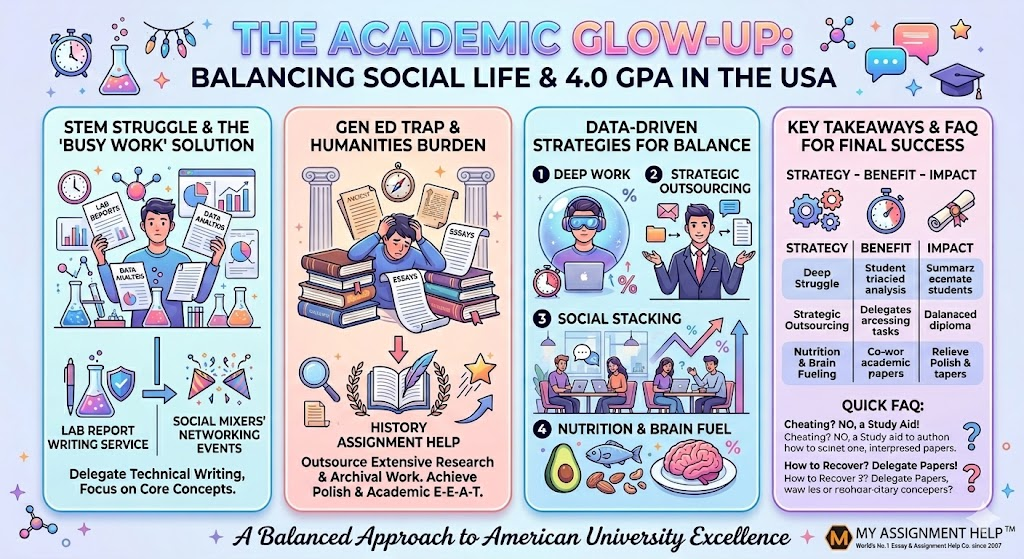
In the modern American landscape of “hustle culture” and the “Main Character” aesthetic, the term “Glow-Up” has evolved. It is no longer just about skincare routines or wardrobe overhauls; it is about the Academic Glow-Up. For the Gen Z and Alpha cohorts currently navigating US universities, the ultimate status symbol is the ability to maintain a vibrant social life, a curated personal brand, and a flawless 4.0 GPA.
However, the reality of the US higher education system is rigorous. With the average college student spending roughly 15 to 17 hours per week on classwork alone—excluding lectures—the “social-academic” see-saw often feels broken. Achieving a “Soft Life” in academia requires more than just better highlighters; it requires a strategic, data-driven approach to time management and resource delegation.
The STEM Struggle: Automating the “Busy Work”
For students in Science, Technology, Engineering, and Mathematics (STEM) tracks, the workload is disproportionately weighted toward technical documentation. Research indicates that STEM majors spend nearly 50% more time on out-of-class assignments compared to their peers in humanities. The primary culprit? Detailed laboratory analysis. Between data collection, error analysis, and formatting to APA or IEEE standards, a single experiment can consume an entire weekend. To reclaim this time without sacrificing their GPA, many savvy students leverage a professional lab report writing service. By delegating the heavy lifting of data formatting and technical writing, students can focus on the core conceptual learning—and still make it to that Friday night rooftop mixer in NYC or LA.
The “Gen Ed” Trap and the Humanities Burden
It isn’t just STEM students feeling the heat. The American “General Education” (Gen Ed) requirements often force students into high-density reading courses that fall outside their primary interest. Whether you are a Marketing major or a Computer Science enthusiast, you likely have to face the daunting “History of Western Civ” or “American Political Traditions.” These courses are notorious for 2,000-word essays and intricate archival research.
When your social calendar is packed with networking events or Greek life commitments, these lengthy papers become bottlenecks. Utilizing expert history assignment help allows students to submit high-quality, evidence-based essays that meet strict E-E-A-T (Experience, Expertise, Authoritativeness, and Trustworthiness) standards. This isn’t just about getting a grade; it’s about strategic delegation to ensure every aspect of your “Academic Glow-Up” remains polished.
5 Data-Driven Strategies for the Ultimate 4.0 Balance
To truly master the balance, you need a framework that goes beyond simple “to-do” lists.
1. The “Power Hour” vs. The “Deep Work” Method
Cal Newport’s concept of “Deep Work” suggests that 90 minutes of intense, distraction-free focus is more productive than four hours of “shallow” studying while scrolling TikTok.
- The Hack: Use the Pomodoro technique (50 mins work / 10 mins break) specifically for high-impact tasks.
2. Strategic Outsourcing (The CEO Mindset)
Top-tier CEOs don’t do their own bookkeeping; they hire experts. Apply this to your degree. If a specific assignment—like a complex SQL database or a 30-page history thesis—is a “low-interest, high-effort” task, outsource the research and drafting phases to specialized services.
3. The “Social Stacking” Technique
Don’t choose between friends and finals. “Body doubling” or co-working sessions at aesthetic cafes are a staple of the modern US student experience. It provides accountability while satisfying the need for social interaction.
4. Leveraging E-E-A-T in Your Own Writing
When you do write your own papers, ensure they signal authority. Use peer-reviewed sources from databases like JSTOR or Google Scholar. This reduces the “re-write” time because your initial arguments are backed by hard data.
5. Nutrition and “Brain Fuel”
Data from the American Journal of Clinical Nutrition suggests a direct correlation between Omega-3 intake and cognitive retention. Your “Glow-Up” must include physical maintenance to support mental performance.
Key Takeaways for a Successful Semester
| Strategy | Benefit | Impact on GPA |
| Outsourcing Technical Tasks | Saves 10-15 hours per week | Maintains precision in STEM |
| Deep Work Sessions | Reduces “Brain Fog” | Increases retention by 40% |
| Gen Ed Delegation | Frees up time for Major-specific study | Balances the transcript |
| Aesthetic Co-working | Combines social & academic goals | Improves mental well-being |
FAQ Section
Q1: Is using an academic writing service considered “cheating” in the USA?
A: Not when used as a study aid. Think of it as a “model paper.” It provides a high-quality blueprint that shows you how to structure your data, cite sources correctly, and meet academic standards.
Q2: How can I improve my GPA if I have already fallen behind?
A: Start with “Grade Recovery.” Focus on your upcoming high-value assignments (Finals and Midterms). Outsourcing a few heavy-duty papers can give you the breathing room to catch up on missed readings.
Q3: What are the most reliable history assignment help sources?
A: Look for services that employ subject matter experts with Masters or PhDs in History. They should offer primary source analysis and adhere to Chicago or Turabian citation styles, which are standard in US History departments.
Q4: How do I maintain my “Glow-Up” during finals week?
A: Prioritize sleep and hydration. Use “The CEO Mindset” to delegate tasks that are keeping you up past midnight, and use that time for REM sleep instead.
Author Bio
Sarah is a Senior Academic Consultant and Content Strategist at MyAssignmentHelp. With over 10 years of experience in the US higher education sector, she specializes in helping students navigate the complexities of E-E-A-T compliant writing and SEO-driven academic research. Sarah is passionate about empowering students to achieve their “Academic Glow-Up” through strategic resource management and data-backed study habits.
References & Sources
- National Survey of Student Engagement (NSSE) – Data on student study habits.
- Bureau of Labor Statistics (BLS) – Time Use Survey for American College Students.
- Newport, C. (2016). Deep Work: Rules for Focused Success in a Distracted World.
- TEQSA & AQF Standards (2026 Updates) regarding Academic Integrity and Support.
